Explanation
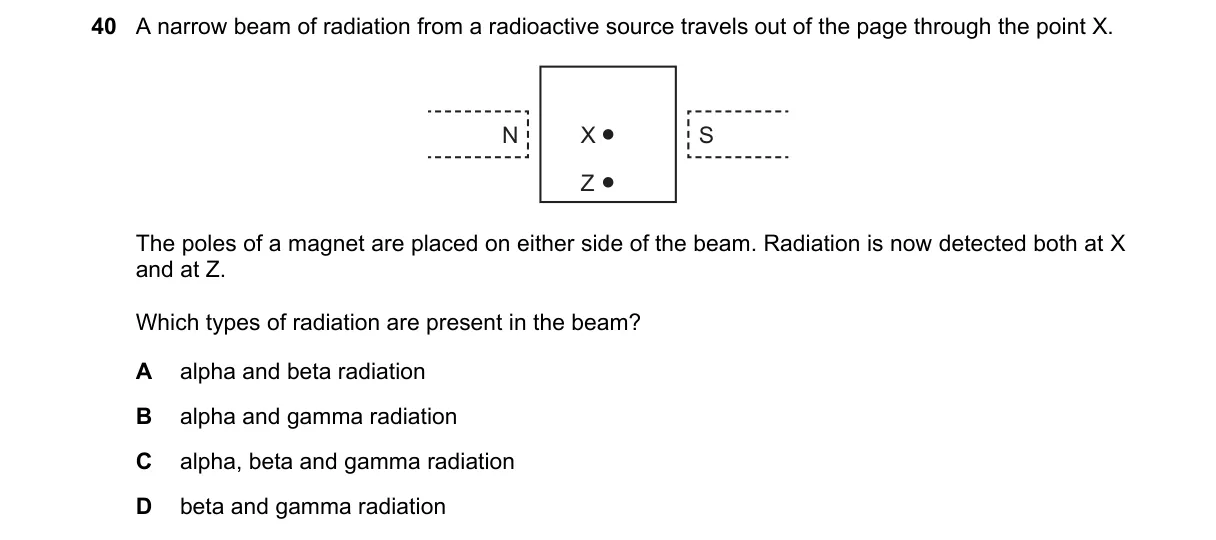
Magnetic deflection of radioactive particles Steps: - Alpha particles (+ charged, heavy) deflect slightly in one direction; beta particles (- charged, light) deflect sharply in the opposite direction; gamma rays (neutral) remain undeflected. - The narrow beam passes through X; magnet poles create a field perpendicular to the beam, separating paths. - Detection at X indicates undeflected gamma rays. - Detection only at Z (one deflected position) indicates beta particles deflecting there; no opposite deflection rules out alpha. Why D is correct: - Beta deflects sharply to Z due to low mass and charge, while gamma stays at X, matching two detection points per Lorentz force law (F = qvB sinθ). Why the others are wrong: - A: Alpha and beta would produce deflections in opposite directions, requiring three detection points (no gamma for X). - B: Alpha deflects minimally opposite to beta but not to Z; with gamma, only one main spot at X, no Z. - C: All three would show gamma at X, beta at Z, and alpha at an opposite point, but only two points detected. …
Practice more O Levels Physics (5054) questions on mMCQ.me