O Levels Physics (5054)•5054/11/O/N/19
Explanation
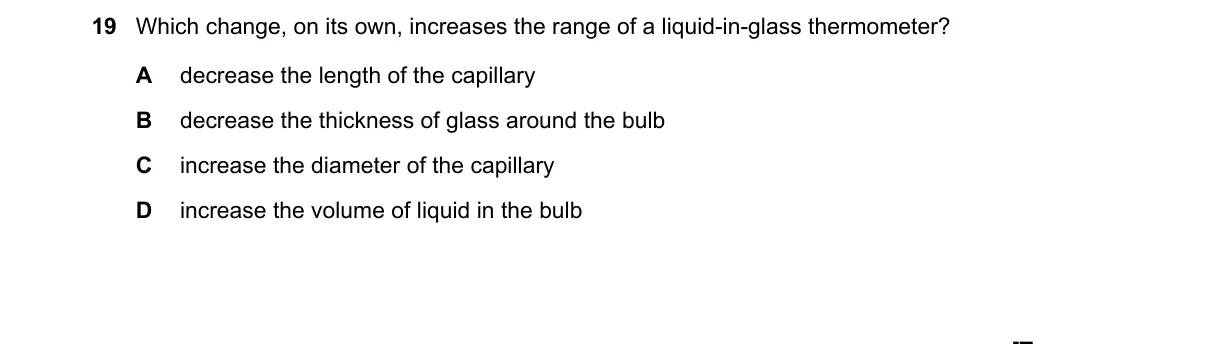
Capillary diameter controls liquid rise for a given expansion
Steps:
- Thermometer range is the temperature span until liquid reaches capillary top.
- Liquid expansion volume = α × V_bulb × ΔT, where α is expansion coefficient.
- Rise height h = expansion volume / (π r² L), but for fixed L, range ΔT ∝ 1 / (π r²).
- Increasing r (diameter) increases cross-sectional area, reducing h for same ΔT, thus extending range.
Why C is correct:
- Larger capillary diameter increases bore area (∝ r²), so same expansion volume causes less rise, allowing greater ΔT before overflow (from volume flow formula).
Why the others are wrong:
- A: Shorter capillary reduces total length, so liquid reaches top sooner, decreasing range.
- B: Thinner glass affects heat transfer but not expansion volume or capillary capacity, so range unchanged.
- D: More bulb liquid increases expansion volume for same ΔT, causing faster rise and shorter range.
Final answer: C
Topic: Thermal expansion of solids, liquids and gases
Practice more O Levels Physics (5054) questions on mMCQ.me