O Levels Physics (5054)•5054/11/O/N/19
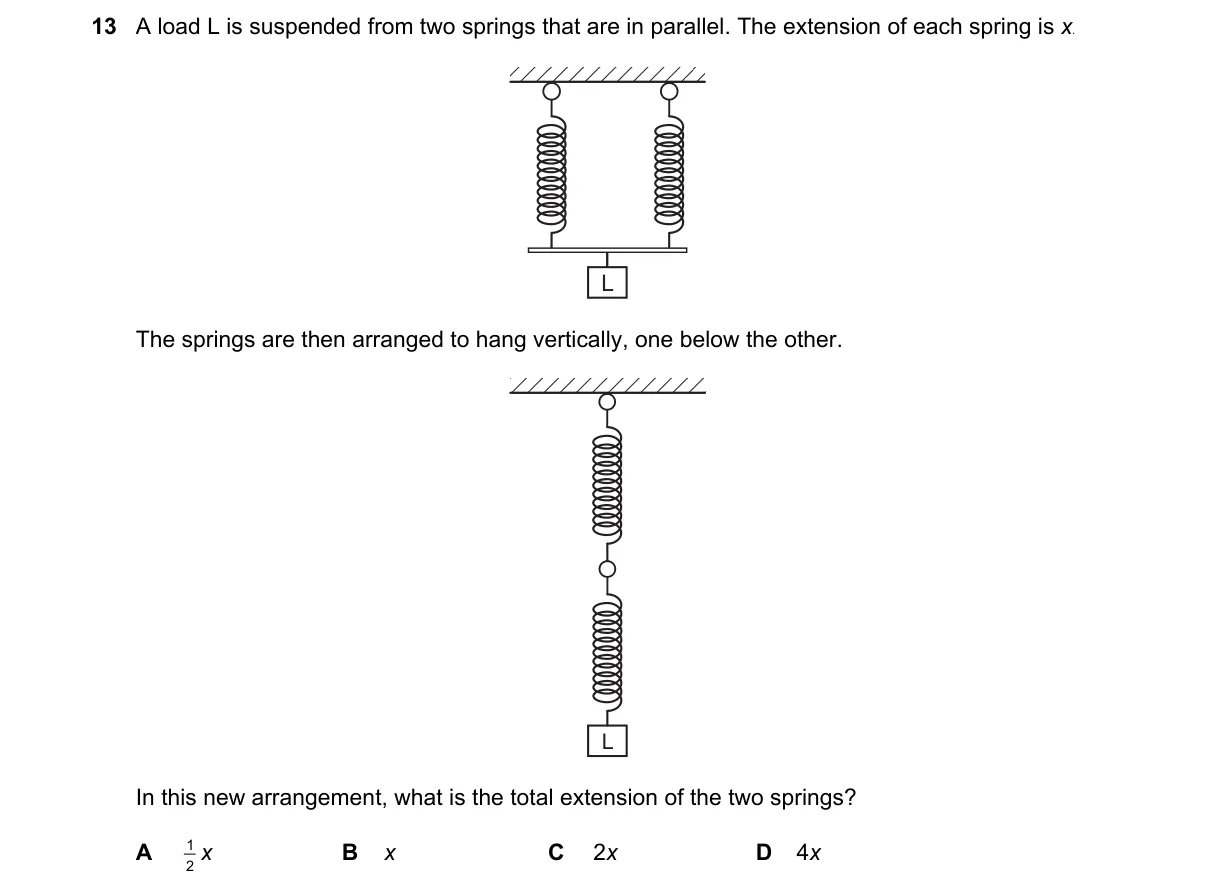
Explanation
Series vs. parallel spring extensions
Steps:
- In parallel, load L is shared equally; each spring bears L/2 and extends by x, so spring constant k = (L/2)/x = L/(2x).
- In series, springs connect end-to-end; effective spring constant k_eff = k/2 for identical springs.
- Total extension in series is δ = L / k_eff = L / (k/2) = 2L/k.
- Substitute k = L/(2x) to get δ = 2L / (L/(2x)) = 2 * 2x = 4x.
Why D is correct:
- Hooke's law for series combination: total extension doubles for each spring's individual extension under full load, yielding 4x from parallel baseline.
Why the others are wrong:
- A: x/2 ignores load redistribution, underestimating series extension.
- B: x assumes parallel extension persists, neglecting series weakening.
- C: 2x matches single-spring doubling but misses parallel's halved force per spring.
Final answer: D
Topic: Elastic deformation
Practice more O Levels Physics (5054) questions on mMCQ.me