Explanation
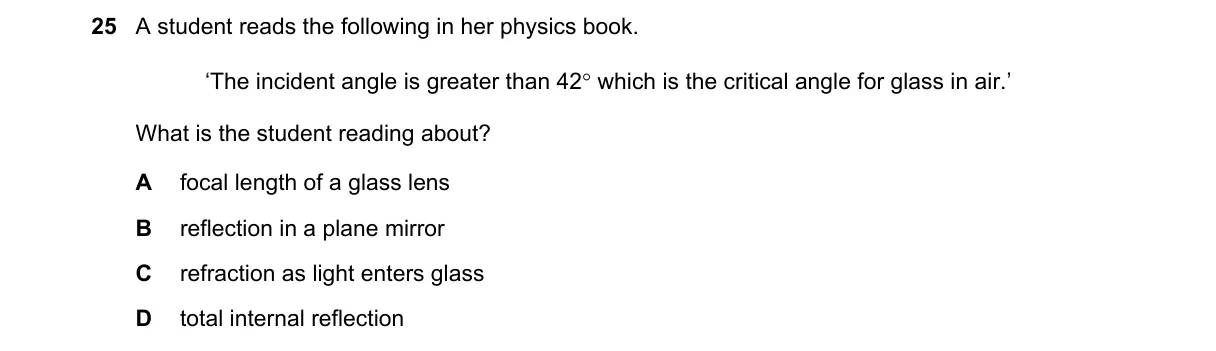
Total Internal Reflection Steps: - Identify key terms: "incident angle greater than 42°" and "critical angle for glass in air" refer to light behavior at a glass-air boundary. - Recall that the critical angle is the threshold where light rays inside a denser medium (glass) no longer refract into a rarer medium (air) but reflect entirely. - Connect to options: This scenario matches total internal reflection, not refraction or reflection in mirrors. - Eliminate unrelated concepts: Focal length involves lenses, plane mirrors follow angle of incidence equals reflection, and entering glass describes refraction from air to glass. Why D is correct: - Total internal reflection occurs when the angle of incidence exceeds the critical angle (about 42° for glass-air), causing all light to reflect internally per Snell's law (n1 sin θc = n2 sin 90°). Why the others are wrong: - A: Focal length relates to lens convergence/divergence, not angles at boundaries. - B: Plane mirror reflection follows equal angles but lacks a critical angle. - C: Refraction entering glass happens for angles below the critical angle from air to …
Practice more O Levels Physics (5054) questions on mMCQ.me