O Levels Physics (5054)•5054/11/M/J/24
Explanation
Understanding Nuclear Fusion as an Energy Source
Steps:
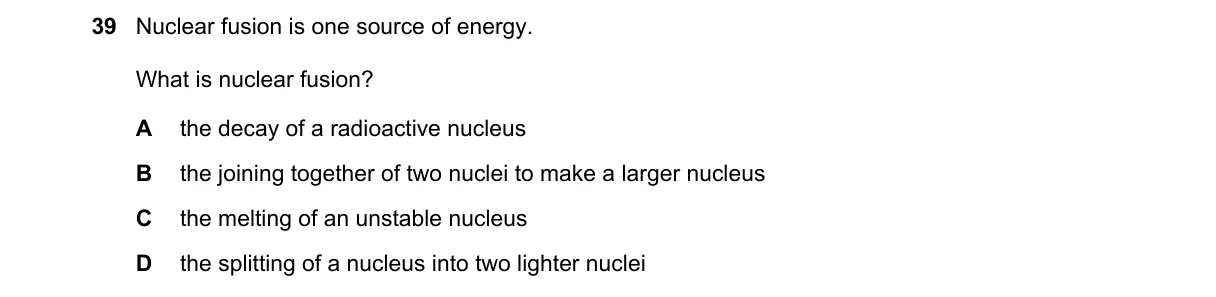
- Recall that nuclear fusion involves light atomic nuclei combining to form a heavier nucleus, releasing energy.
- Compare this to the choices: identify which describes joining of nuclei.
- Eliminate options related to decay, melting, or splitting, as they describe other nuclear processes.
- Confirm the match with the standard definition of fusion.
Why B is correct:
- Nuclear fusion is defined as the process where two light nuclei join to form a heavier nucleus, releasing energy per Einstein's mass-energy equivalence (E=mc²), powering stars like the Sun.
Why the others are wrong:
- A describes radioactive decay, which emits particles and energy from unstable nuclei without joining.
- C refers to a phase change, not a nuclear reaction; nuclei don't "melt."
- D describes nuclear fission, where heavy nuclei split into lighter ones, as in atomic bombs or reactors.
Final answer: B
Topic: Fission and fusion
Practice more O Levels Physics (5054) questions on mMCQ.me