O Levels Physics (5054)•5054/12/M/J/23
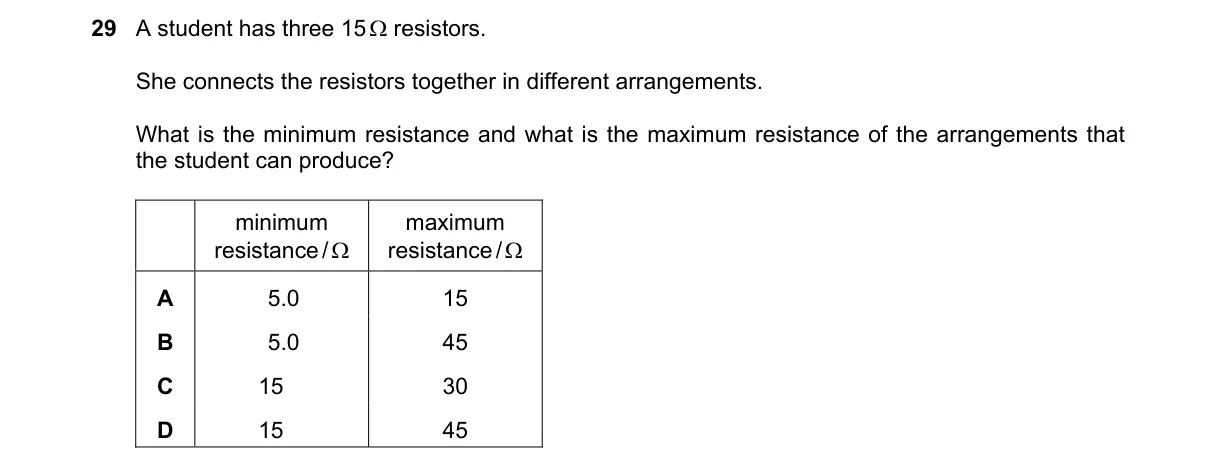
Explanation
Series and parallel resistor combinations Steps:
- Maximum resistance occurs when all three resistors are connected in series: total R = R + R + R = 3R.
- Minimum resistance occurs when all three are connected in parallel: 1/R_min = 1/R + 1/R + 1/R = 3/R, so R_min = R/3.
- For R = 15 Ω, maximum = 45 Ω and minimum = 5.0 Ω.
- Other arrangements (e.g., two in series with one in parallel) yield values between 5 Ω and 45 Ω.
Why B is correct:
- Option B matches the series formula (3R = 45 Ω) and parallel formula (R/3 = 5.0 Ω) for three equal resistors.
Why the others are wrong:
- A: Underestimates maximum (15 Ω is two in series, not all three).
- C: Swaps min/max and ignores parallel reduction to 5 Ω.
- D: Overestimates minimum (15 Ω is a single resistor, not using all three in parallel).
Final answer: B
Topic: Series and parallel circuits
Practice more O Levels Physics (5054) questions on mMCQ.me