O Levels Physics (5054)•5054/12/M/J/21
Explanation
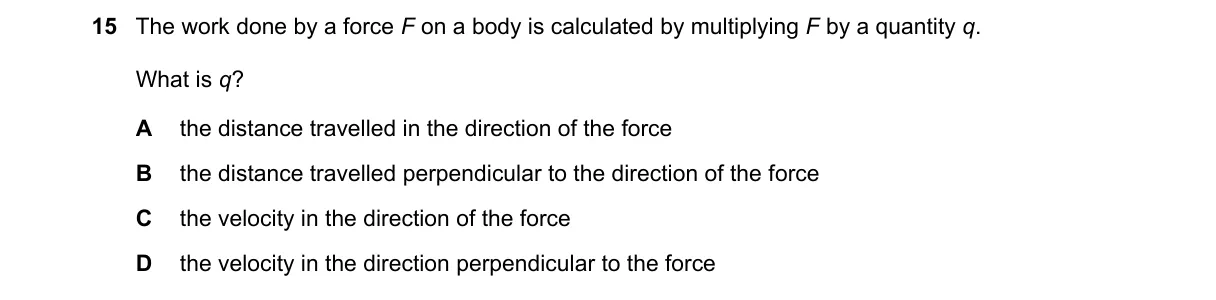
Work-energy principle: work equals force times parallel displacement
Steps:
- Recall the definition of work in physics: work done by a force is the product of the force and the displacement component in the force's direction.
- Use the formula W = F · d = F d cosθ, where θ is the angle between force and displacement.
- For work to be F times q, q must be the displacement parallel to F (when θ=0, cosθ=1, q=d).
- Eliminate options involving velocity, as work involves displacement, not speed.
Why A is correct:
- By the work definition, W = F s, where s is displacement in the force's direction, directly matching the formula.
Why the others are wrong:
- B: Perpendicular displacement yields cos90°=0, so work is zero, not F times distance.
- C: Velocity relates to power (P = F v), not work, which requires displacement.
- D: Perpendicular velocity also ties to power components, irrelevant to work calculation.
Final answer: A
Topic: Work
Practice more O Levels Physics (5054) questions on mMCQ.me