O Levels Physics (5054)•5054/12/M/J/20
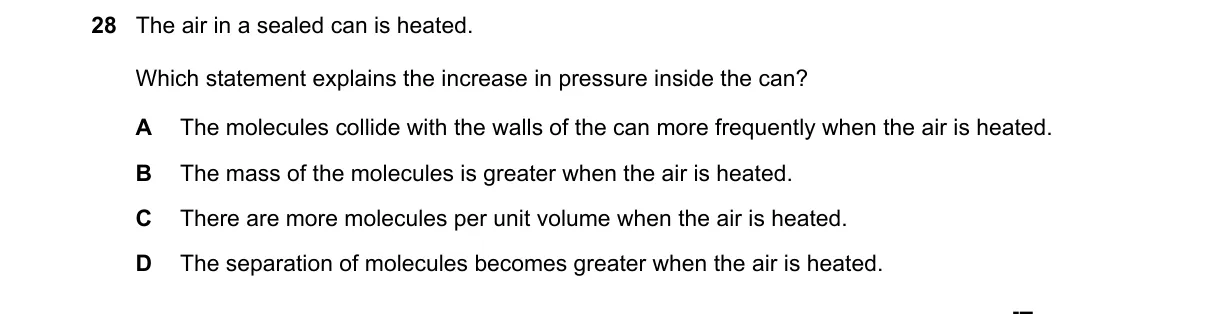
Explanation
Kinetic Molecular Theory and Gas Pressure
Steps:
- Heating the air increases the average kinetic energy of gas molecules.
- Higher kinetic energy means molecules move faster.
- In a sealed can, volume and number of molecules remain constant.
- Faster molecules collide more frequently and forcefully with the can walls, increasing pressure.
Why A is correct:
- According to the kinetic molecular theory, gas pressure results from molecular collisions with container walls; increased temperature raises collision frequency, directly boosting pressure (from ideal gas law PV = nRT, where T rise at constant V increases P).
Why the others are wrong:
- B: Heating does not change the mass of molecules; mass is invariant.
- C: In a sealed can, the number of molecules and volume are fixed, so molecules per unit volume stays the same.
- D: At constant volume, average molecular separation depends on number density, which does not increase with heating.
Final answer: A
Topic: Particle model
Practice more O Levels Physics (5054) questions on mMCQ.me