O Levels Physics (5054)•5054/12/M/J/20
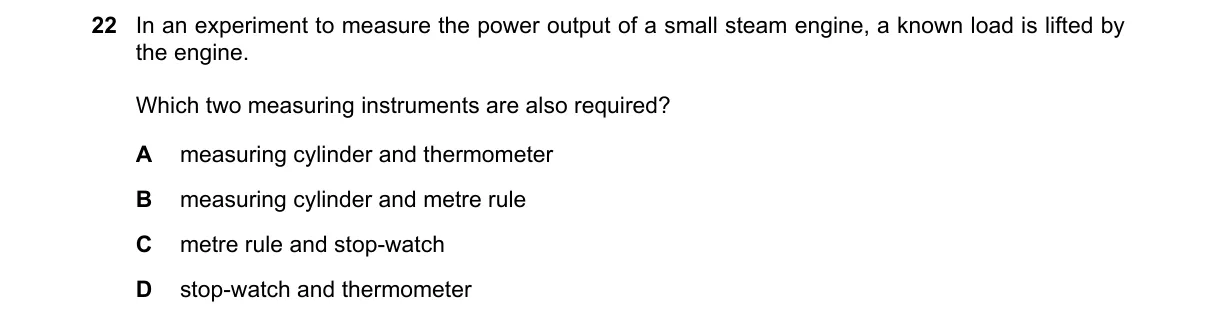
Explanation
Measuring mechanical power via work and time
Steps:
- Power output is calculated as P = W/t, where W is work done (force × distance) and t is time.
- Force comes from the known load's weight (mass × g).
- Distance is the vertical height lifted, measured directly.
- Time is the duration to lift the load, measured precisely.
Why C is correct:
- Metre rule measures height (distance) for work (W = F × d); stop-watch measures time (t) for power (P = W/t), per the physics definition of power.
Why the others are wrong:
- A: Measuring cylinder assesses volume (e.g., steam), thermometer measures temperature—irrelevant to mechanical work or time.
- B: Measuring cylinder is unnecessary for power; metre rule is useful but incomplete without time measurement.
- D: Stop-watch measures time but thermometer only checks temperature, omitting distance for work.
Final answer: C
Topic: Power
Practice more O Levels Physics (5054) questions on mMCQ.me