mMCQ.

Navigation Menu

Step into mMCQ.

Launch mMCQ. diagnostic

Explore mMCQ.

MDCAT prepFree DiagnosticPricing & SubscribeSign in

Resources

Terms & Conditions

mMCQ.

© 2021 - 2025 mMCQ.All rights reserved.

WhatsApp
O Levels Physics (5054)•5054/11/M/J/20
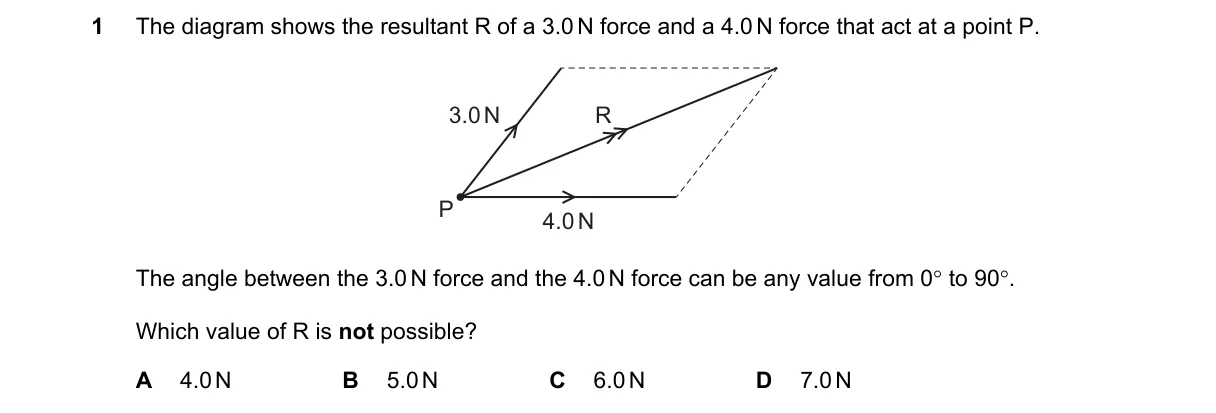
Question 1 from 5054/11/M/J/20

Explanation

Resultant force magnitude ranges from 5 N to 7 N for angles 0° to 90° Steps: - Use the formula for resultant magnitude: R=32+42+2⋅3⋅4⋅cos⁡θ=25+24cos⁡θR = \sqrt{3^2 + 4^2 + 2 \cdot 3 \cdot 4 \cdot \cos \theta} = \sqrt{25 + 24 \cos \theta}R=32+42+2⋅3⋅4⋅cosθ​=25+24cosθ​, where θ\thetaθ is the angle between forces. - At θ=0∘\theta = 0^\circθ=0∘, cos⁡0∘=1\cos 0^\circ = 1cos0∘=1, so R=25+24=49=7R = \sqrt{25 + 24} = \sqrt{49} = 7R=25+24​=49​=7 N (maximum). - At θ=90∘\theta = 90^\circθ=90∘, cos⁡90∘=0\cos 90^\circ = 0cos90∘=0, so R=25=5R = \sqrt{25} = 5R=25​=5 N (minimum). - For 0∘<θ<90∘0^\circ < \theta < 90^\circ0∘<θ<90∘, RRR varies continuously between 5 N and 7 N. Why A is correct: - 4 N is less than the minimum possible resultant of 5 N, per the parallelogram law of vector addition. Why the others are wrong: - B: 5 N occurs exactly at θ=90∘\theta = 90^\circθ=90∘. - C: 6 N is between 5 N and 7 N, achievable at an intermediate …

Topic: Balanced and unbalanced forces

Practice more O Levels Physics (5054) questions on mMCQ.me