O Levels Physics (5054)•5054/12/M/J/19
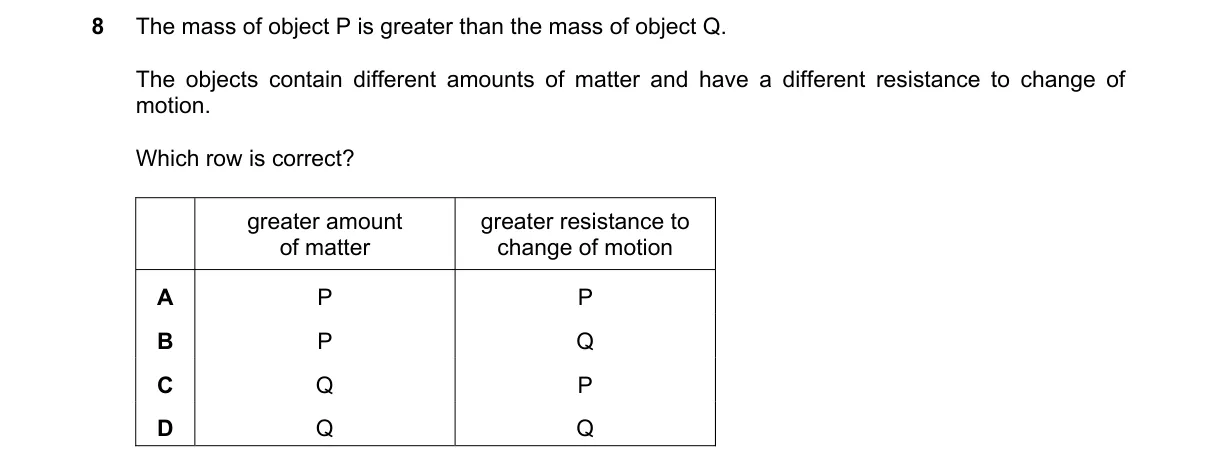
Explanation
Mass determines amount of matter and inertia
Steps:
- Mass of P exceeds mass of Q, as stated.
- Mass quantifies the amount of matter in an object.
- Resistance to change of motion defines inertia, proportional to mass.
- Thus, P has more matter and greater inertia than Q.
Why A is correct:
- Inertia equals mass (Newton's first law); P's greater mass means greater matter and resistance to motion change.
Why the others are wrong:
- B: Q has less mass, so less matter and resistance, not greater.
- C: P has greater matter, but Q has less resistance due to lower mass.
- D: Q has neither greater matter nor greater resistance.
Final answer: A
Topic: Mass and weight
Practice more O Levels Physics (5054) questions on mMCQ.me