O Levels Physics (5054)•5054/12/M/J/19
Explanation
Ideal Gas Molecular Motion Between Collisions
Steps:
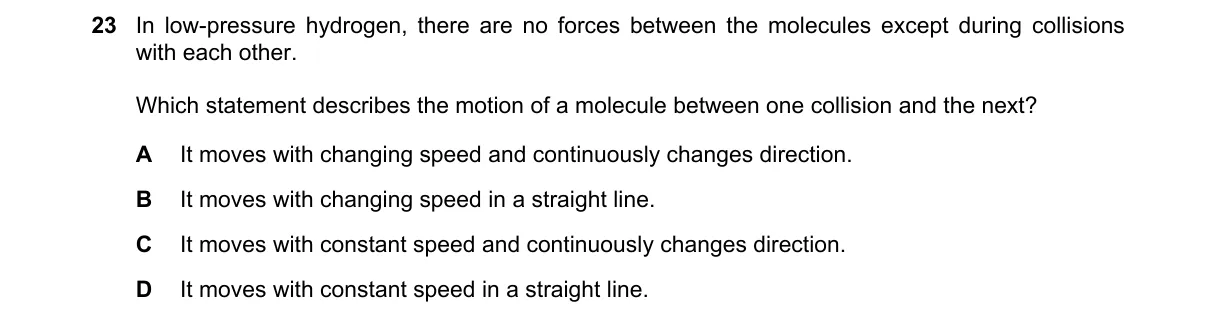
- Low-pressure hydrogen approximates ideal gas behavior, where intermolecular forces are negligible except during collisions.
- Between collisions, no net forces act on a molecule.
- By Newton's first law, the molecule maintains constant velocity.
- Constant velocity means unchanging speed and straight-line path.
Why D is correct:
- Newton's first law states that without net force, an object moves with constant velocity, implying constant speed in a straight line.
Why the others are wrong:
- A: Changing speed and direction require forces, absent between collisions.
- B: Changing speed implies acceleration from forces, not present.
- C: Changing direction requires force to alter path, but none acts.
Final answer: D
Topic: Particle model
Practice more O Levels Physics (5054) questions on mMCQ.me