O Levels Physics (5054)•5054/12/M/J/18
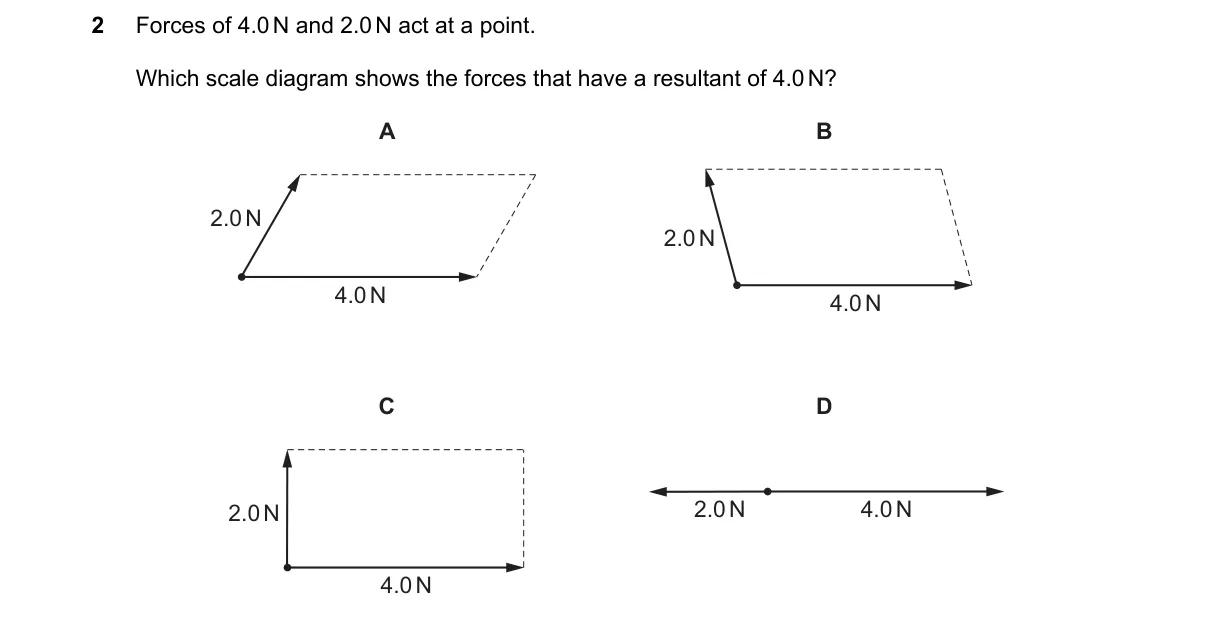
Explanation
Vector Addition for Resultant Force
Steps:
- Identify that two 2N forces yield a 4N resultant only if they act parallel and in the same direction, as R = F1 + F2.
- In a scale diagram, this appears as two arrows aligned end-to-end, totaling 4 units of length.
- Compare options: B shows aligned arrows matching 4N scale.
- Confirm by parallelogram rule: no angle deviation for maximum resultant.
Why B is correct:
- When forces are collinear and same direction, resultant magnitude is vector sum (2N + 2N = 4N) per Newton's vector addition law.
Why the others are wrong:
- A: Arrows oppose, resultant 0N (subtraction).
- C: Arrows at angle (e.g., 90°), resultant ~2.8N (√(2² + 2²)).
- D: Arrows at obtuse angle, resultant <4N but >0N.
Final answer: B
Topic: Balanced and unbalanced forces
Practice more O Levels Physics (5054) questions on mMCQ.me