O Levels Physics (5054)•5054/11/M/J/18
Explanation
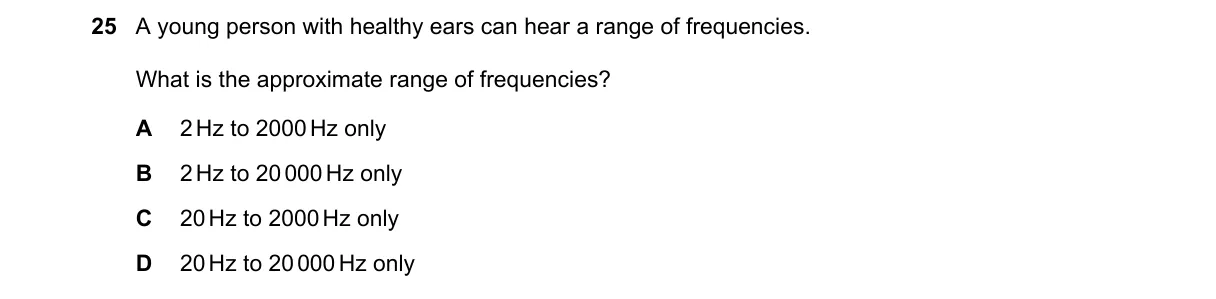
Human audible frequency range
Steps:
- Identify the standard physiological limits for sound perception in young, healthy humans.
- Note the lower threshold where sound becomes audible, around 20 Hz.
- Recognize the upper threshold for high-frequency detection, up to 20,000 Hz in youth.
- Match these limits to the provided options for the full hearing spectrum.
Why C is correct:
- It aligns with the established audiology definition of the human hearing range (20 Hz–20 kHz), covering infrasonic boundary to ultrasonic edge for clear perception.
Why the others are wrong:
- A: Starts at 2 Hz, which is infrasound below audible range, not heard as sound.
- B: Caps at 2000 Hz, excluding higher frequencies like those in speech consonants or music highs.
- D: Identical to B, so same error in limiting upper range.
Final answer: C
Topic: Sound
Practice more O Levels Physics (5054) questions on mMCQ.me