O Levels Economics (2281)•2281/13/O/N/20
Explanation
Division of labour enhances firm efficiency via specialization
Steps:
- Define division of labour as assigning specialized tasks to workers for repetitive production.
- Identify advantages like higher productivity and cost savings from expertise.
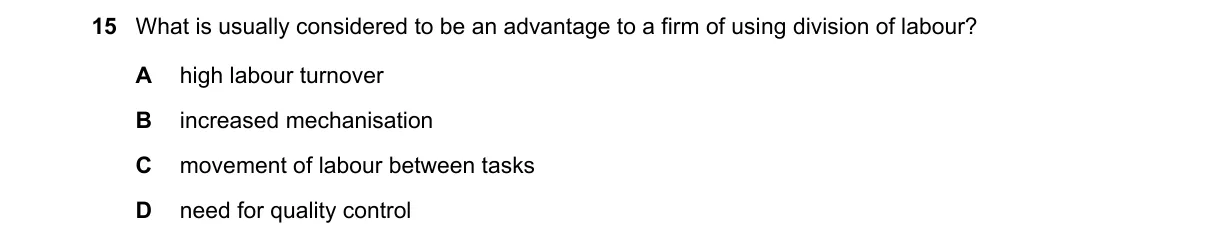
- Evaluate options: A indicates worker dissatisfaction (disadvantage); B enables automation of routine tasks; C promotes generalism (opposite of specialization); D arises from monotony (potential drawback).
- Select B as it directly stems from repetitive tasks suiting machinery.
Why B is correct:
- Division of labour creates repetitive, standardized tasks that facilitate mechanisation, reducing costs and increasing output per Adam Smith's pin factory example.
Why the others are wrong:
- A: High labour turnover results from worker boredom, a disadvantage.
- C: Movement between tasks reduces specialization benefits.
- D: Quality control needs increase due to deskilling, not an advantage.
Final answer: B
Topic: Firms and production
Practice more O Levels Economics (2281) questions on mMCQ.me