O Levels Economics (2281)•2281/12/M/J/24
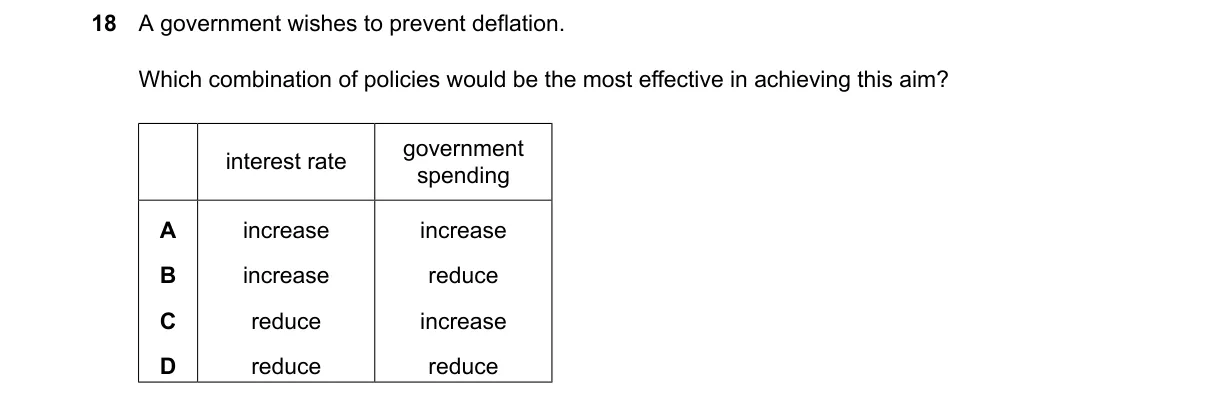
Explanation
Expansionary Policies to Boost Aggregate Demand
Steps:
- Deflation occurs when aggregate demand (AD) falls, causing prices to drop.
- To prevent it, implement expansionary monetary policy by decreasing interest rates to lower borrowing costs and encourage spending/investment.
- Pair with expansionary fiscal policy by increasing government spending to directly inject money into the economy.
- This combination shifts the AD curve rightward, raising prices and output.
Why C is correct:
- Decreasing interest rates stimulates private spending via cheaper loans, while increasing government spending raises AD directly, countering deflation per the Keynesian AD-AS model.
Why the others are wrong:
- A: Increasing rates contracts monetary policy, reducing AD and offsetting spending gains.
- B: Both policies are contractionary, further lowering AD and exacerbating deflation.
- D: Decreasing spending contracts fiscal policy, undermining the expansionary effect of lower rates.
Final answer: C
Topic: Inflation and deflation
Practice more O Levels Economics (2281) questions on mMCQ.me