O Levels Economics (2281)•2281/12/M/J/21
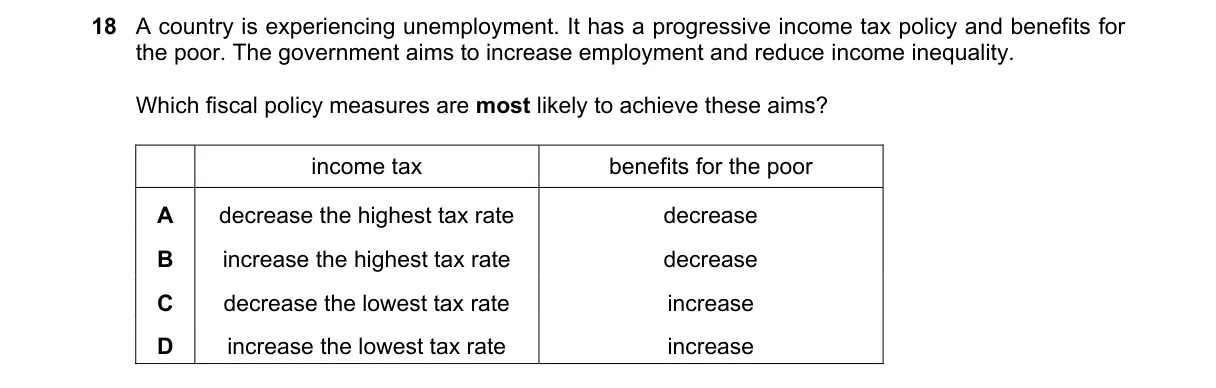
Explanation
Fiscal Policy for Employment and Equity
Steps:
- Identify goals: boost employment via higher spending; reduce inequality via redistribution to low-income groups.
- Assess tax impacts: progressive system taxes higher earners more; lowering lowest rate increases low-income disposable income for consumption-driven growth.
- Evaluate benefits: raising aid to poor enhances their spending power (high multiplier) and narrows income gaps.
- Select option balancing both: tax relief for low earners spurs jobs; benefits aid equity without deterring investment.
Why C is correct:
- Decreasing lowest tax rate raises low-income disposable income, stimulating aggregate demand via Keynesian consumption multiplier; increasing benefits redistributes income, reducing Gini coefficient inequality measure.
Why the others are wrong:
- A: Raises highest tax, curbing rich's investment and employment; cuts benefits, worsening poor's consumption and inequality.
- B: Lowers highest tax, favoring rich and increasing inequality; benefits help equity but offset by regressive tax effect.
- D: Raises lowest tax, reducing poor's spending and jobs; benefits aid equity but contradicted by tax hike on vulnerable.
Final answer: C
Topic: Fiscal policy
Practice more O Levels Economics (2281) questions on mMCQ.me